Wednesday, 10 July 2013

Cumbria - Gamekeeper Convicted for Killing Buzzards

The RSPB have released a video from their covert cameras on you tube showing the Gamekeeper killing the birds. Please be warned, the video is graphic and some people may find it disturbing.
 
 
Colin Burne, of Winters Park, Penrith, pleaded guilty to the intentional killing of buzzards on land managed by a private shooting syndicate in Whinfell Forest, near Penrith, Cumbria.
The 64-year old gamekeeper attended Carlisle Magistrates Court today where he pleaded guilty to three charges. These related to the killing of two buzzards on the 11 February 2013, killing five buzzards prior to this date and possession of a wooden stick as an item capable of being used to kill the birds.
He received a 70-day jail sentence, concurrent on each charge, suspended for 12 months.  In sentencing, the Judge stated that had it not been for his ill health he would have considered jailing him.”
 
Source : RSPB

Tuesday, 9 July 2013

More nest destruction..........?

House Martin at nest (Photo courtesy of RSPB.org)
There is always conflict between man and birds when birds use buildings (or vehicles!!) as nest sites!! House Martins and Swallows are a classic example. House Martins nest under the eaves of houses and other buildings, making a small dome of mud in which to raise their young. The nest, eggs and birds are afforded the same protection as any other birds and it is illegal to remove their nests whilst they are building it or using it. They are particularly late this year and can have a couple of broods, which is worth bearing in mind if you are thinking of knocking down that nest because of the mess they are making. Each egg or young killed can be a fine of up to £5000 or 6 months in prison! We do get a lot of reports at this time of year from concerned neighbours about this problem and we will investigate reports of this kind. Likewise for Swallows who tend to use barns and out buildings to nest. Think twice about removing those nests just because of the mess the birds leave on your car!
 
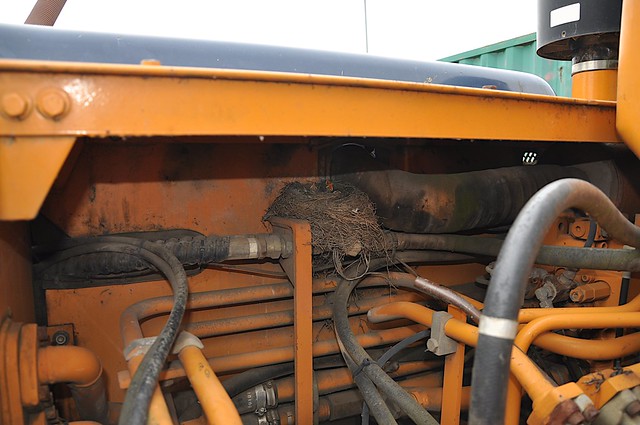
We recently had a report of a Pied Wagtail nesting in a forklift truck that was going to be moved. Fortunately the owner sought advice from the Wildlife Crimes Group and the birds are now safely behind a cordoned off area!
Pied Wagtail nest in machinery (generic image from Flickr)

Japanese Knotweed and the Law

Japanese Knotweed is not the first thing to spring to mind when you think of the flora and fauna you might have to deal with as a wildlife crimes officer! But yesterday the D&C Wildlife Crimes Group did have a query about the invasive invader so we had to do some research. The information below was found at the Japanese Knotweed Solutions website (other Knotweed solution companies are available!!) ands pretty much covers all the law you need to know when dealing with offences for the alien plant.

Due to the destructive characteristics of Japanese Knotweed, strong legislation is in place to control the magnitude of the problem.

Some common legal issues with regards to Japanese Knotweed:

  • It's a criminal offence to cause the spread of Japanese Knotweed under Section 14(2) of the Wildlife and Countryside Act 1981 (WCA 1981)
  • You could face a fine of up to £5,000 and/or 6 months imprisonment if found guilty in a Magistrate's Court, and up to 2 years imprisonment and/or an unlimited fine in a Crown Court.
  • You could be sued (under laws relating to private nuisance under common law) for costs and damages if you allow Japanese Knotweed to spread from your property onto that of an adjacent landowner.
  • The Environmental Protection Act (EPA) 1990, Duty of Care Regulations 1991 state that cut Japanese Knotweed material and soil containing rhizomes must be disposed of as controlled waste.
  • You will have to pay to dispose of controlled waste containing Japanese knotweed at a licensed landfill.
  • You need a Waste Carrier's licence when transporting controlled waste for business or profit, and you must follow strict guidelines.
  • If you fail to show that you have the authority to transport controlled waste, you may be issued with a Fixed Penalty Notice. The penalty fine is currently set at £300.
  • You are not allowed to put any Japanese knotweed material in to any of your local council-provided bins, or in public rubbish bins.
  • Your mortgage lender can legally refuse to give you a mortgage if Japanese Knotweed is recorded on your property or a nearby property.
On the up-side:
  • It’s not illegal to have it on your land
  • It’s not a "notifiable weed"
  • It's not classed as an "Injurious Weed" (as defined by the Weeds Act 1959)
For further description of Japanese Knotweed legislation, please refer to the Environment Agency's code of practice ‘Managing Japanese knotweed on development sites', a copy of which can be found on the Environment Agency's website here

The other up-side of course is that the stuff can be made into some delicious recipes and also wine and other alcoholic drinks!!

Friday, 5 July 2013

What are we up to?....................

Just to keep you up to date with wildlife crimes we are currently dealing with across the force, the D&C Wildlife Crimes Group are presently investigating:  2x buzzard poisonings, one allegation of unlawful hunting, suspected gassing of badger set, A badger set interference, 3 nest disturbances/destructions, 2x disturbance/destruction of significant bat roost and a CITES offence. We are also looking into a lot of Deer poaching allegations and an illegal fishing incident! All of the above are ongoing investigations and as such we cannot elaborate at this time, but we will publish the results of these jobs on our blog as and when we can. 
Deer killed by poachers in Devon

Despite our heavy workload, we would like to encourage you to continue reporting ALL suspected wildlife crime in Devon and Cornwall. Please call 101 (for non-emergency) to report widlife crime or intelligence.

Wednesday, 3 July 2013

Marine Wildlife Crimes Training

Officers from D&C Wildlife Crimes Group attended a morning of Marine Crimes Training last week hosted by Cornwall College at the Durrell Centre for Wildlife Education, Newquay. (What a superb venue!!)

We were treated to a very interesting talk by Faye Archell about many aspects of Marine crime that we as officers may have to deal with. The programme followed a species theme, with each animal or family group discussed individually. It was a great opportunity to learn a bit about the animals lifestyles and movements as well as the laws and legislation surrounding each one. After this we all joined with staff at the college in the lecture theatre to discuss the job of a WCO. After an impromptu but informative speech by Sgt Dave Knight, each WCO in turn stood up (some remained seated!) and explained their current role in the force as well as a bit about themselves and the WCO role.
This was very well received by the staff and there was of course a few humorous moments! A short question and answer session followed before we retired for a very nice lunch! We must say a big thanks to all the staff at Cornwall College for being such superb hosts and allowing us to meet at their wonderful facility. It is hoped we have formed a strong bond with the college which we will enhance in the future with more partnership training for staff, students and WCO's.
 
For more information on best practice for watching marine wildlife see HERE